 |
Mr Vivekanandan Dhukaram
MB, MS (Orth), MSc, FRCS Ed, FRCS Orth Consultant Orthopaedic Surgeon - Foot and Ankle Specialist University Hospitals Coventry & Warwickshire |
| Home | About Dhukaram | For Patients | For GPs | For Physiotherapist | Blog | Contact |

Ankle Fracture .......................................... Ingrowing Toe Nail .......................................... Plantar Fasciitis .......................................... Private Consultation FAQs .......................................... You can see me at: BMI The Meridian Hospital, Walsgrave Hospital Site, Clifford Bridge Road, Coventry, CV2 2LQ Warwickshire Nuffield Hospital, Old Milverton Lane, Leamington Spa, Warwickshire, CV32 6RWI To book an appointment email  or by calling my secretary on 07881434444
 |
Plantar Fasciitis/ Heel
Pain What is plantar fasciitis? Plantar fascia is a tough fibrous sheet supporting the arch of foot that spans between heel to toes. Plantar fasciitis is the commonest cause of heel pain that develops due to inflammation at its insertion in heel. Often, you recover from symptoms in 6 to 18 months but occasionally prolonged. The treatment helps you to cope with symptoms and fastens recovery. 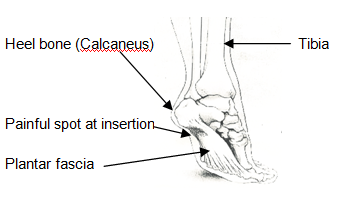 What are the symptoms? Pain at inner aspect of heel, could be burning or throbbing in nature. Symptoms are often, worse in the morning or after a period of rest. What are the causes of plantar fasciitis? - Due to abnormal stress, either due to overweight or prolonged periods on feet - Individuals with tight Achilles tendon and high-arched feet are at risk of developing plantar fasciitis due to increased stress. - Inflammatory arthritis can affect any tendon or ligament insertion to bone. - Worn out footwear, inappropriate footwear or step up in activity could lead to plantar fasciitis. What are the other causes of heel pain apart from plantar fasciitis? - Heel fat pad atrophy (thinning of heel fat pad) - Tarsal tunnel syndrome (Compression of nerve on inner side of heel) - Arthritis of ankle joint or Subtalar joint (joint below the ankle) - Stress fracture of the heel bone Do plantar fasciitis is associated with heel spur? Heel spur is not the cause of pain however, may be an effect of plantar fasciitis. Heel spur may be noted in the absence of symptoms and vice-versa. What measures could I take to manage the pain? - Appropriate footwear with cushioned insoles to reduce the stress. Over the counter silicone supports would be helpful. - Non-steroidal anti-inflammatory drugs (e.g. brufen, neurofen) - Reduce the bodyweight if you are overweight - Special insoles if you have high arched feet to act as shock absorber - Physiotherapy to stretch the tight Achilles tendon as shown below What should I do if symptoms fail to improve with the above measures? You should consult your doctor and your doctor may refer you to the specialist. Further options of treatment are - Short period of rest in a plaster cast - Further physiotherapy - Injection of local anaesthetic with steroid with or without ultrasound guidance to dampen the inflammation - Local pain relieving measures such as TENS, acupuncture, ESWT - Night splint to avoid tightening of Achilles while in bed - Surgery is the last option where 1 to 2% of patients may need it. What does surgery entail? A 3 to 4 cm cut at inner heel, releasing part of the plantar fascia to reduce the tension in it. This is usually combined with the release of tight fascial bands to free up the nerve from compression. However, the success of the surgery is not very predictable. Physiotherapy Stand on a step and support yourself only on the forefoot, holding your knees straight. Drop your heel enough to feel the stretch in the calf muscles and hold for 10 seconds. Repeat the same for 10 times, atleast 3 sessions a day Stand at arm’s length from a wall with your back knee held straight and the front knee bent. Bend the front knee further maintaining the contact of both heels on the ground. If you are doing it right, should feel the stretching pain in the calf muscle. Hold for 10 seconds and repeat the same with the other leg. Repeat the same for 10 times, atleast 3 sessions a day. In certain feet, the tightness of Achilles tendon may swing the heel outwards rather than effectively stretching the tendon. In such case, advised to stand on outer border of the feet, sole facing inwards to avoid the heel swing and do the same exercises. Place a cool can of soft drink under your heel/ instep and roll it backwards and forwards for few minutes. Repeat the same 3 times a day IT MAY TAKE TIME, BUT PERSEVERE, YOU WILL GET BETTER |
| Home | About Dhukaram | For Patients | For GPs | For Physiotherapist | Blog | Contact |