 |
Mr Vivekanandan Dhukaram
MB, MS (Orth), MSc, FRCS Ed, FRCS Orth Consultant Orthopaedic Surgeon - Foot and Ankle Specialist University Hospitals Coventry & Warwickshire |
| Home | About Dhukaram | For Patients | For GPs | For Physiotherapist | Blog | Contact |

Ankle Fracture .......................................... Ingrowing Toe Nail .......................................... Plantar Fasciitis .......................................... Private Consultation FAQs .......................................... You can see me at: BMI The Meridian Hospital, Walsgrave Hospital Site, Clifford Bridge Road, Coventry, CV2 2LQ Warwickshire Nuffield Hospital, Old Milverton Lane, Leamington Spa, Warwickshire, CV32 6RWI To book an appointment email  or by calling my secretary on 07881434444
 |
Ankle Fracture What is an ankle fracture? The ankle joint constitutes lower end of tibia (shin bone) and talus(foot bone). The talus is stabilised within the ankle mortice by medial malleolus (tibia) on innerside and fibular on the outerside(lateral malleolus). The ankle fracture is a break of medial malleolus or lateral malleolus or both bones (bi-malleolar fracture). At times the talus may completely pop out of the ankle joint associated with fracture termed as fracture dislocation. 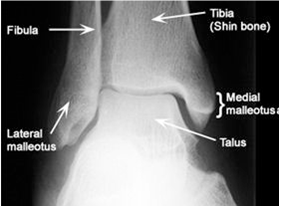 How does an ankle fracture happen? Ankle fractures are usually caused by a twisting injury to the ankle resulting from sport or a simple fall. What is the treatment for ankle fractures? The treatment of ankle fracture is determined by whether your ankle joint stay in a good position (stable) or risk of ankle joint moving out of position (unstable). For the ankle joint to be unstable there should be injury on both inner and outerside of the ankle. This could be either fracture or combination of ligament injury and fracture. Stable fractures : These injuries can be safely treated using plaster cast for 6 weeks duration apart from very few exceptions. Unstable fracture : Problems will occur if the bones heal in an incorrect position. So, these fractures require operative fixation as long as you are fit to have surgery. If the shape and anatomy of the ankle is not accurately restored, the cartilage lining of the ankle is disturbed, which will inevitably lead to arthritis. Reconstructing the ankle reduces the risk of arthritis developing to a minimum. What will happen if I decide not to have the operation? You will be treated using a plaster cast. You will need to keep the weight off your leg by using crutches or a walking frame to move about. You will need regular X-rays to check the position of the bones in the plaster. If the bones stay out of position and heal in an incorrect position, the ankle will not function well. ANKLE FRACTURE TREATMENT The aim is to allow the fractured bones heal in the correct place. If your ankle is broken and unstable, you are fit enough to undergo surgery, you ought to have the fracture fixed. This can be achieved by fixing the bones in position with plates and screws. Your type of operation will depend on the type of fracture. This should be discussed with your surgeon. 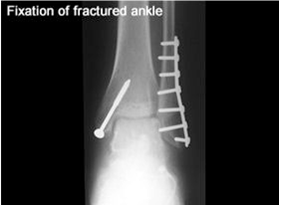 My ankle is very swollen and bruised. If your ankle is very swollen your surgeon will not operate straight away. You will have to wait for the swelling to go down. This may take as long as 7-10 days. You may be sent home with advice on elevation and ice application till swelling subsides to operate. Specialist nurse would contact you by telephone on alternate days to address any concerns. You can help reduce the swelling by raising your leg as high as possible (above the level of groin) on pillows. Packed ice applied to the area also helps to reduce the swelling. What does the operation involve? One or more cuts are made to expose the broken bones on the inner and outer sides of the ankle. The fractures are usually fixed using screws and a plate. The cuts are then closed with stitches or staples.br /> Possible complications. • You will be given pain relief to control the pain. It is important to take it as instructed so you can move about as advised. • Scarring, of the skin (although ankle wounds usually heal to a neat scar). • Blood clots in the legs (thrombosis). These can occasionally move through the bloodstream to the lungs (embolus), causing breathing difficulties (risk less than 1 in a 100). You will be encouraged to get out of bed soon after surgery, drink plenty of fluids and will be given a daily injection to reduce the risks of blood clots. • If you have difficulty in passing urine you may need a catheter for a day or two. Complications specific to this operation. • Infection. If this occurs it will be treated with antibiotics or occasionally a further operation. Infection can sometimes stop the fracture healing. • Loosening or breaking of the plate and screws. This can happen if the bone is very soft or if too much weight is placed on the leg before the fracture has healed properly. A further operation is usually needed. •• Continued tenderness over the plate and screws. It is possible to have a further operation to remove the plate and screws when the fracture has healed; but they are not usually removed unless they cause problems. Going Home During the first couple of weeks you will need to keep your leg raised on pillows or a footstool, as much as possible to help keep the swelling down. As you begin to move about more, remember to use your walking aids as instructed. You will be asked to go to the fracture clinic to check that the fracture is healing properly (an appointment will be sent to you). Your ankle may be kept in a plaster cast until the bones heal which usually takes 6-8 weeks. Your surgeon and physiotherapists will advise you when you can place weight on your ankle and you will be given exercises to help your ankle start moving again. It can take several months before you are able to return to normal activities. If you have any problems or concerns, please contact your GP. What about the future? Most patients make a good recovery after surgery with a return to good mobility of the ankle. However, your ankle may never be quite as strong as it was before the injury. Some swelling and mild stiffness is common and can last for several months after the fracture has healed. There is a risk of developing arthritis due to the injury itself, but it is usually mild. |
| Home | About Dhukaram | For Patients | For GPs | For Physiotherapist | Blog | Contact |